
Stainless Steel Seamless vs Welded Pipe: Differences, Applications & How to Choose
- Siddhgiri Overseas
When sourcing stainless steel pipes for an industrial project, one of the first decisions is whether to choose a seamless or welded stainless steel pipe.
Both types are widely used across industries, but they are manufactured differently and can have different dimensional characteristics, availability, cost considerations, and suitability depending on the application.
A seamless pipe is manufactured without a longitudinal welded seam, while a welded pipe is produced by forming stainless steel material into a tubular shape and welding the joint. However, the presence or absence of a weld alone does not determine which option is suitable for a project.
Operating pressure, temperature, corrosion conditions, dimensions, material grade, applicable standards, inspection requirements, and budget should all be considered.
In this guide, Siddhgiri Overseas explains the key differences between stainless steel seamless vs welded pipes, their applications, advantages, and factors to consider before requesting a quotation.
What Is a Seamless Stainless Steel Pipe?
A seamless stainless steel pipe is manufactured without a longitudinal welded joint.
The manufacturing process generally begins with a solid billet that is heated and pierced to form a hollow section. The material is then processed to achieve the required dimensions and properties according to the applicable manufacturing specification.
Because there is no longitudinal weld seam, seamless pipes are commonly specified for many demanding industrial applications.
They are available in different stainless steel grades, sizes, wall thicknesses, schedules, and specifications.
Common applications include:
- Oil and gas processing
- Chemical and petrochemical plants
- Power generation
- High-pressure systems
- Heat exchangers
- Boilers
- Process piping
- Marine applications
- Pharmaceutical processing
However, seamless construction should not automatically be interpreted as being better for every application. The actual suitability depends on the relevant design code and project requirements.
What Is a Welded Stainless Steel Pipe?
A welded stainless steel pipe is manufactured by forming stainless steel strip, sheet, or plate into a cylindrical shape and joining the edges with a longitudinal weld.
Depending on the manufacturing specification and intended application, the welded area may undergo additional processing, inspection, testing, or heat treatment.
Modern welding and inspection technologies allow welded stainless steel pipes to be used across a wide range of industrial applications.
They are commonly used in:
- Water treatment systems
- Chemical processing
- Food and beverage processing
- Pharmaceutical systems
- Structural applications
- Large-diameter piping
- General process piping
- Pulp and paper facilities
- Marine applications
Welded pipes can be particularly useful when larger diameters or specific dimensional requirements are needed.
Seamless vs Welded Stainless Steel Pipe: Quick Comparison
Here is a simple comparison:
| Factor | Seamless Stainless Steel Pipe | Welded Stainless Steel Pipe |
|---|---|---|
| Construction | No longitudinal welded seam | Contains a welded seam |
| Starting material | Commonly solid billet | Strip, sheet or plate |
| Size availability | Depends on manufacturing range | Broad range, including large diameters |
| Wall thickness | Various schedules available | Various wall thicknesses available |
| Dimensional consistency | Depends on manufacturing specification | Can offer good dimensional consistency |
| Pressure applications | Frequently specified for demanding pressure service | Suitable where permitted by design specification |
| Cost | Can be more expensive | Often more economical in comparable specifications |
| Large diameters | May have manufacturing limitations | Commonly available |
| Applications | Process, pressure and demanding services | Process, structural and general industrial systems |
These are general differences. Actual performance depends on the stainless steel grade, manufacturing standard, dimensions, testing requirements, operating conditions, and quality of manufacturing.
How Are Seamless Stainless Steel Pipes Manufactured?
Understanding the manufacturing process helps explain why seamless pipes have different characteristics.
A typical process begins with a solid stainless steel billet.
1. Billet Preparation
A suitable stainless steel billet is selected according to the required material grade and specification.
2. Heating
The billet is heated to a suitable temperature for further processing.
3. Piercing
The heated billet is pierced to create a hollow section.
4. Sizing and Reduction
The hollow section undergoes additional processing to achieve the required outside diameter and wall thickness.
5. Heat Treatment
Depending on the material and specification, heat treatment may be performed to obtain the required metallurgical and mechanical properties.
6. Finishing and Testing
The pipe may undergo straightening, cutting, surface treatment, dimensional inspection, and specified testing before final supply.
The exact manufacturing sequence varies depending on the product, grade, dimensions, and governing standard.
How Are Welded Stainless Steel Pipes Manufactured?
Welded pipes follow a different manufacturing route.
1. Material Preparation
Stainless steel strip, sheet, or plate is selected according to the required grade and dimensions.
2. Forming
The material is formed into a cylindrical shape.
3. Welding
The edges are joined using an appropriate welding process.
4. Weld Processing
Depending on the specification, the weld area may undergo additional finishing or processing.
5. Heat Treatment
Heat treatment may be performed when required by the manufacturing standard or material specification.
6. Inspection and Testing
The finished pipe is inspected and tested according to the applicable specification and customer requirements.
Proper manufacturing, welding, inspection, and testing are important for ensuring that the finished product meets its specified requirements.
Advantages of Seamless Stainless Steel Pipes
Seamless pipes offer several characteristics that make them appropriate for particular applications.
No Longitudinal Weld Seam
The defining characteristic of seamless pipe is that it does not contain a longitudinal welded joint.
This can be an important requirement in projects where seamless construction is specifically required by the design specification.
Suitable for Demanding Applications
Seamless stainless steel pipes are commonly specified for demanding process, pressure, temperature, and corrosive-service applications when required by the relevant engineering design.
Availability in Multiple Stainless Steel Grades
Seamless pipes can be supplied in commonly used grades such as 304/304L and 316/316L stainless steel, as well as various higher-alloy materials depending on availability and specification.
Advantages of Welded Stainless Steel Pipes
Welded pipes also offer important commercial and technical benefits.
Large Diameter Availability
Welded manufacturing can make it practical to produce larger-diameter stainless steel pipes.
This can be particularly important for industrial piping projects requiring dimensions that may be difficult or uneconomical to manufacture through seamless processes.
Cost Considerations
For certain dimensions, quantities, and specifications, welded pipes may provide a more economical solution.
Cost, however, should be compared using the complete technical specification rather than simply comparing seamless and welded construction.
Dimensional Control
The forming and welding process can provide consistent dimensions, although actual tolerances depend on the relevant product standard.
Broad Industrial Usage
Properly manufactured and tested welded stainless steel pipes are widely used in process industries, water systems, structural projects, food processing, pharmaceutical facilities, and other industrial applications.
Is Seamless Stainless Steel Pipe Stronger Than Welded Pipe?
This is one of the most common questions buyers ask, but there is no universal answer based only on whether a pipe is seamless or welded.
Pipe performance depends on several factors, including:
- Material grade
- Outside diameter
- Wall thickness
- Manufacturing standard
- Heat treatment
- Mechanical properties
- Weld quality, where applicable
- Operating pressure
- Operating temperature
- Corrosion environment
- Applicable design code
A properly manufactured welded pipe that meets the required specification may be suitable for many demanding applications.
Similarly, seamless construction does not eliminate the need to verify material properties, dimensions, testing, and compliance.
Therefore, buyers should select pipes according to engineering and project requirements rather than assuming that seamless automatically means stronger or better.
Seamless vs Welded Pipe for High-Pressure Applications
Seamless pipes are frequently specified for high-pressure applications because they do not contain a longitudinal welded seam.
However, this should not be treated as a universal selection rule.
The appropriate pipe should be determined according to the system's design pressure, temperature, dimensions, material properties, corrosion allowance, applicable design code, and project specification.
For critical applications, the project engineer or relevant engineering specification should determine whether seamless or welded construction is required.
Which Stainless Steel Grades Are Available?
Both seamless and welded pipes can be manufactured from various stainless steel grades.
304/304L Stainless Steel
304 and 304L stainless steel pipes are widely used for general industrial applications because of their combination of corrosion resistance, fabrication characteristics, and availability.
316/316L Stainless Steel
316 and 316L stainless steel pipes contain molybdenum and provide improved resistance to certain forms of corrosion compared with 304, particularly in chloride-containing environments.
They are commonly considered for chemical processing, marine, pharmaceutical, food-processing, and other corrosive environments.
Duplex Stainless Steel
Duplex stainless steel pipes combine characteristics of austenitic and ferritic stainless steels and offer high strength along with good resistance to various forms of corrosion.
They are used in industries such as chemical processing, oil and gas, marine, and offshore applications.
Super Duplex Stainless Steel
Super Duplex stainless steel pipes are used for demanding applications requiring high strength and enhanced corrosion resistance, including environments involving chlorides and seawater.
The appropriate grade should always be selected based on the actual operating conditions and project specification.
Seamless vs Welded Pipe for Different Industries
The choice can vary significantly depending on the industry and application.
Oil and Gas
Oil and gas systems may use seamless or welded pipes depending on pressure, temperature, fluid characteristics, dimensions, applicable codes, and project specifications.
Chemical and Petrochemical
Corrosion resistance is particularly important in chemical processing.
The material grade can be just as important as whether the pipe is seamless or welded.
Marine and Offshore
Marine environments expose materials to chlorides and other corrosive conditions.
Grades such as 316/316L, Duplex, and Super Duplex may be considered depending on the severity of the environment and engineering requirements.
Food and Pharmaceutical
Material composition, surface condition, cleanliness, fabrication quality, and applicable sanitary requirements are important considerations.
Power Generation
Power plants can require stainless steel piping for systems operating under different combinations of temperature, pressure, and corrosive conditions.
The pipe must be selected according to the applicable system design.
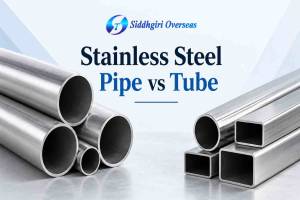
Stainless Steel Pipe vs Tube: Don't Confuse the Two
Another common sourcing mistake is treating stainless steel pipes and tubes as exactly the same product.
Although they may look similar, their sizing conventions and applications can differ.
Pipes are generally specified using Nominal Pipe Size (NPS) and schedules, while tubes are commonly specified according to their actual outside diameter and wall thickness.
If you're unsure about this distinction, read our guide on Stainless Steel Pipe vs Tube: Key Differences Explained before placing your enquiry.
How to Choose Between Seamless and Welded Stainless Steel Pipe
Instead of asking which pipe is universally better, ask which product meets your project's technical requirements.
Consider these factors before ordering:
Operating pressure: Determine the system's design and operating pressure.
Temperature: Consider normal and maximum operating temperatures.
Corrosion environment: Identify the fluids, chemicals, chlorides, moisture, or other corrosive substances the pipe may encounter.
Material grade: Select the appropriate stainless steel grade based on corrosion resistance, mechanical properties, and applicable specification.
Pipe size: Determine the required NPS and outside diameter.
Schedule or wall thickness: Select according to engineering requirements.
Manufacturing type: Determine whether seamless or welded construction is required.
Standard: Specify applicable ASTM, ASME, EN, DIN, or other standards.
Testing: Identify any hydrostatic, ultrasonic, eddy-current, PMI, or other testing requirements specified by the project.
Documentation: Specify requirements such as material test certificates or inspection documentation.
Quantity and length: Provide the required quantity and pipe lengths.
Providing these details makes it easier for a supplier to quote the correct product.
What Information Should You Include in an RFQ?
For faster and more accurate quotations, an RFQ for stainless steel pipes should ideally contain:
| Requirement | Example |
|---|---|
| Product | Stainless Steel Seamless Pipe |
| Grade | 316L |
| Size | NPS as required |
| Schedule | SCH 40 |
| Manufacturing | Seamless |
| Standard | Applicable ASTM/ASME specification |
| Length | Required length |
| Quantity | Required quantity |
| Testing | As per project requirement |
| Certification | As required |
For welded pipes, specify welded instead of seamless along with any applicable manufacturing, testing, or inspection requirements.
Source Seamless and Welded Stainless Steel Pipes from Siddhgiri Overseas
Siddhgiri Overseas supplies stainless steel pipes and tubes for a wide range of industrial requirements.
Our product portfolio includes stainless steel and specialty-alloy products for applications across industries such as chemical processing, oil and gas, marine, power generation, automotive, aerospace, and general engineering.
Depending on your requirements, products can be supplied in different:
- Material grades
- Sizes
- Schedules and wall thicknesses
- Specifications
- Seamless and welded configurations
- Industrial standards
Siddhgiri Overseas also deals in specialized materials including Duplex, Super Duplex, Monel, Inconel, Hastelloy, and other corrosion-resistant alloys for demanding industrial applications.
Share your grade, size, schedule, standard, quantity, and application requirements with Siddhgiri Overseas to request a quotation for your project.
Frequently Asked Questions
What is the main difference between seamless and welded stainless steel pipe?
A seamless stainless steel pipe does not contain a longitudinal welded seam. A welded stainless steel pipe is manufactured by forming stainless steel material and joining its edges through welding.
Which is better: seamless or welded stainless steel pipe?
Neither is universally better. The appropriate option depends on pressure, temperature, dimensions, material grade, applicable standards, application, availability, and project requirements.
Is seamless stainless steel pipe more expensive?
Seamless pipe can be more expensive for certain sizes and specifications because of its manufacturing process. Actual pricing depends on grade, dimensions, quantity, market conditions, testing, and other requirements.
Can welded stainless steel pipe be used for pressure applications?
Yes, welded stainless steel pipes can be used for pressure applications when permitted by the applicable specification and design code and when the pipe meets the required manufacturing, inspection, and testing requirements.
What grades are available for seamless and welded stainless steel pipes?
Common stainless steel grades include 304/304L and 316/316L. Duplex, Super Duplex, and other specialty alloys may also be available depending on the required specification.
What should I provide when requesting a stainless steel pipe quotation?
Provide the material grade, size, schedule or wall thickness, seamless or welded construction, applicable standard, length, quantity, testing requirements, certification requirements, and any relevant project specifications.