
When Should You Choose 304L or 316L Stainless Steel Pipes for Welded Applications?
- Siddhgiri Overseas
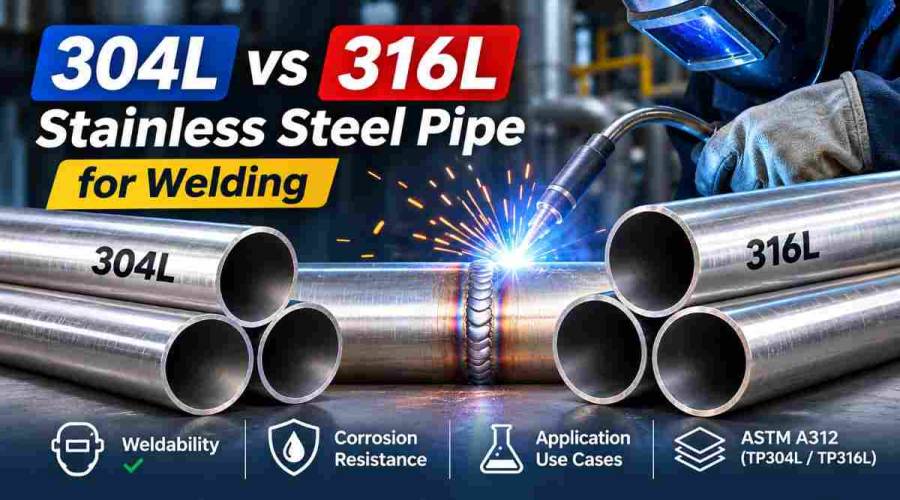
Choosing stainless steel piping for a welded system is not simply about selecting a corrosion-resistant material. The pipe must also withstand welding temperatures, operating conditions, cleaning procedures, and long-term exposure to process fluids.
Two commonly specified materials are 304L and 316L stainless steel pipes. Both are low-carbon austenitic stainless steels designed to reduce the risk of sensitization during welding. However, they offer different levels of resistance to certain corrosive environments.
The main difference is that 316L contains molybdenum, which improves resistance to chloride-related pitting and crevice corrosion. Meanwhile, 304L remains a practical and economical option for many welded systems operating in less aggressive environments.
For engineers, fabricators, and procurement teams, understanding these differences helps prevent incorrect material selection and unnecessary project costs.
This guide explains when to select each grade, how welding affects corrosion resistance, and what specifications buyers should verify before ordering.
What Is the Main Difference Between 304L and 316L Stainless Steel Pipes?
The primary difference between 304L and 316L stainless steel pipes is their alloy composition and resistance to localized corrosion.
Both grades contain chromium and nickel, which support the formation of a protective passive layer on the steel surface. However, 316L also contains approximately 2–3% molybdenum, improving its resistance to pitting and crevice corrosion in many chloride-containing environments.
304L does not contain a deliberate molybdenum addition and is commonly used in general industrial piping, equipment fabrication, and relatively mild process environments.
316L is frequently selected when piping is exposed to more demanding conditions, including certain chemical processes, coastal environments, and chloride-containing fluids.
Both grades have a maximum carbon content of 0.03%, helping reduce chromium carbide precipitation in the heat-affected zone during welding.
Buyers can explore SS 304L stainless steel pipes and SS 316L stainless steel pipes to review the available material options.
Why Are Low-Carbon Stainless Steel Grades Preferred for Welded Applications?
Low-carbon stainless steel grades are preferred because they reduce the risk of intergranular corrosion associated with chromium carbide precipitation during welding.
When austenitic stainless steel is exposed to certain elevated temperatures, chromium carbides can form along grain boundaries. This process may reduce chromium availability near those boundaries, making the affected regions more vulnerable to corrosion.
This phenomenon is called sensitization.
How Does the Low Carbon Content Improve Weldability?
The reduced carbon content in 304L and 316L limits carbide formation during typical welding thermal cycles.
As a result, these grades are widely used for:
-
Welded process piping
-
Industrial tanks and pressure-containing components
-
Food and beverage processing equipment
-
Chemical handling systems
-
Fabricated pipe assemblies
-
Equipment requiring multiple welded connections
Although the low-carbon composition improves resistance to sensitization, proper welding procedures and surface treatment remain important.
The material grade alone cannot compensate for poor shielding, contamination, or incorrect joint preparation.
When Should Engineers Choose 304L Stainless Steel Pipes?
Engineers should choose 304L stainless steel pipes when the application requires reliable weldability and general corrosion resistance without significant chloride exposure.
The grade is widely used in industrial environments where process fluids are relatively mild and operating conditions are well controlled.
Is 304L Suitable for Food and Beverage Processing?
Yes. 304L is commonly used in food and beverage equipment when the processing environment, cleaning chemicals, and hygiene requirements are compatible with the grade.
Typical applications include:
-
Beverage transfer lines
-
Dairy processing equipment
-
Food production piping
-
Sanitary equipment fabrication
-
Water distribution systems
The final selection should consider cleaning agents, chloride concentrations, operating temperatures, and required surface finish.
Can 304L Be Used for Chemical Processing?
304L can be suitable for handling certain chemicals and process fluids, depending on their concentration, temperature, and exposure conditions.
It is important to evaluate the actual chemical environment rather than assuming all stainless steels offer universal chemical resistance.
For projects involving extensive welded fabrication but limited chloride exposure, 304L may offer an effective balance between performance and material cost.
When Should Engineers Choose 316L Stainless Steel Pipes?
Engineers should consider 316L stainless steel pipes when the piping system is exposed to chloride-containing fluids or other environments where improved localized corrosion resistance is necessary.
The molybdenum addition generally gives 316L better pitting and crevice corrosion resistance than 304L.
Is 316L Better for Coastal and Marine Environments?
316L is commonly preferred over 304L for many coastal and marine-exposed applications because it offers improved resistance to chloride-related corrosion.
However, 316L is not immune to corrosion in seawater or aggressive chloride environments.
Its suitability depends on factors such as water temperature, chloride concentration, oxygen availability, flow conditions, and the presence of crevices.
For severe marine service, engineers may need to consider duplex stainless steels or higher-alloy materials rather than relying on 316L alone.
Why Is 316L Used in Pharmaceutical and Chemical Processing?
316L is frequently selected for pharmaceutical manufacturing, hygienic piping, and certain chemical processing systems because of its corrosion resistance and suitability for controlled surface finishing.
Applications may include:
-
Pharmaceutical processing equipment
-
Purified water distribution systems
-
Chemical transfer piping
-
Industrial washdown systems
-
High-cleanliness fabricated assemblies
Material selection must still consider applicable process standards, surface roughness requirements, cleaning methods, and the chemicals involved.
How Does Welding Affect the Corrosion Resistance of 304L and 316L Pipes?
Welding can affect the corrosion resistance of both grades through heat tint formation, surface oxidation, and contamination.
During welding, high temperatures can produce colored oxide layers on the metal surface. These areas may have reduced corrosion resistance, particularly where the surface is exposed to aggressive chemicals or chlorides.
Why Is Weld Heat Tint Removal Important?
Heat tint should be removed where necessary to restore corrosion performance and meet the intended service requirements.
Appropriate treatment methods can include mechanical cleaning, pickling, and electrochemical weld cleaning.
Fabricators should also avoid using tools contaminated with carbon steel, as embedded iron particles can lead to surface rust staining.
Industry guidance emphasizes that weld cleaning is important for maintaining corrosion resistance in stainless steel fabrication.
worldstainless+1
Can the Same Welding Procedure Be Used for 304L and 316L?
Both grades are generally weldable using processes such as TIG, MIG, and other suitable welding methods.
However, the filler metal must match the intended service and joint requirements.
Commonly used filler metals include:
-
ER308L for many 304L welding applications
-
ER316L for many 316L welding applications
Dissimilar-metal joints or specialized service conditions may require different filler materials.
For pressure piping and critical welded components, engineers should use qualified welding procedures according to the applicable construction code.
Which Material Standards Apply to 304L and 316L Stainless Steel Pipes?
ASTM A312/A312M is a widely used specification for seamless, welded, and heavily cold-worked austenitic stainless steel pipes intended for high-temperature and general corrosive service.
The relevant designations are TP304L and TP316L.
The specification establishes requirements for chemical composition, mechanical properties, manufacturing, heat treatment, and applicable testing.
ASTM Store+1
Before purchasing, engineers should verify the following details:
-
Material grade and applicable ASTM specification
-
Pipe manufacturing method
-
Nominal pipe size and wall thickness schedule
-
Dimensional tolerances
-
Required surface finish
-
Material test certificates
-
Additional inspection requirements
-
Applicable piping design code
The appropriate material standard should be selected according to the actual application. Pipe specifications should not automatically be substituted for tubing specifications.
How Should Engineers Compare 304L and 316L for Long-Term Corrosion Performance?
Engineers should compare the grades according to their actual operating environment rather than assuming the more expensive alloy is always necessary.
For general industrial applications involving mild fluids and controlled environments, 304L may provide sufficient corrosion resistance.
Where chloride exposure creates a greater risk of localized corrosion, 316L is often a better starting point.
However, temperature, concentration, crevice geometry, surface condition, and fluid movement also affect corrosion behavior.
The Nickel Institute identifies these environmental factors as important considerations when evaluating chloride-related corrosion risk.
FlipHTML5+1
Does 316L Always Last Longer Than 304L?
No. The service life of either material depends on operating conditions, fabrication quality, maintenance, and exposure.
In a mild environment where both grades are suitable, 316L may not provide a meaningful practical advantage.
In more corrosive conditions, its additional alloying elements can offer improved protection.
Engineers should assess the full service environment before making the final selection.
What Should Buyers Check Before Ordering 304L or 316L Stainless Steel Pipes?
Buyers should verify the technical requirements, supporting documentation, and delivery specifications before approving a purchase.
A clear purchase inquiry helps suppliers provide suitable material and reduces the possibility of costly fabrication problems.
The following information should be included:
-
Material grade: TP304L or TP316L
-
Applicable standard: ASTM A312/A312M or another specified standard
-
Pipe dimensions: Nominal size, outside diameter, and wall thickness schedule
-
Manufacturing method: Seamless or welded, as required
-
Surface finish: Suitable for the intended processing environment
-
Inspection requirements: Relevant mechanical, chemical, and nondestructive testing
-
Material documentation: Mill Test Certificate and required traceability
-
Operating conditions: Process fluid, temperature, pressure, and corrosion exposure
Buyers planning welded installations should also confirm any project-specific welding, inspection, and post-fabrication cleaning requirements.
Siddhgiri Overseas provides stainless steel welded pipes for industrial and fabrication requirements, with material selection based on the specifications provided by customers.
Frequently Asked Questions About 304L and 316L Stainless Steel Pipes
Which Is Better for Welding, 304L or 316L?
Both grades offer good weldability because of their low carbon content. The appropriate choice depends primarily on service conditions and corrosion requirements, provided suitable welding procedures are used.
Is 316L More Corrosion-Resistant Than 304L?
Yes, 316L generally provides better resistance to chloride-related pitting and crevice corrosion because it contains molybdenum. However, neither grade is completely resistant to all corrosive environments.
Do 304L and 316L Require Post-Weld Heat Treatment?
Post-weld solution annealing is generally not required solely to prevent sensitization after typical welding operations involving these low-carbon grades. Other heat treatment requirements may apply under specific service conditions or construction codes.
Can 304L Be Used Instead of 316L?
304L may be suitable if the operating conditions do not require the additional corrosion resistance of 316L. Substitution should be approved by the responsible engineer after reviewing the relevant material and application specifications.
What Is the Difference Between ASTM A312 TP304L and TP316L?
Both designations fall under ASTM A312 for austenitic stainless steel pipes. TP316L contains molybdenum, while TP304L does not have a deliberate molybdenum addition. This makes TP316L more resistant to certain localized corrosion mechanisms.
Where Can You Buy 304L and 316L Stainless Steel Pipes for Welded Applications?
Selecting the correct stainless steel grade requires an understanding of the process environment, fabrication requirements, and material specifications.
Siddhgiri Overseas, based in Mumbai, India, supplies stainless steel pipes and tubes for industrial, engineering, and fabrication applications.
Its range includes low-carbon stainless steel grades suitable for different welded piping requirements, subject to the requested specifications and availability.
Whether your project requires 304L for general fabrication or 316L for more demanding corrosion conditions, clearly defined material requirements are essential for reliable procurement.
Request a Quote for 304L or 316L Stainless Steel Pipes
Contact Siddhgiri Overseas with your required grade, dimensions, pipe schedule, quantity, material standard, and delivery location to discuss suitable products and request a quotation.