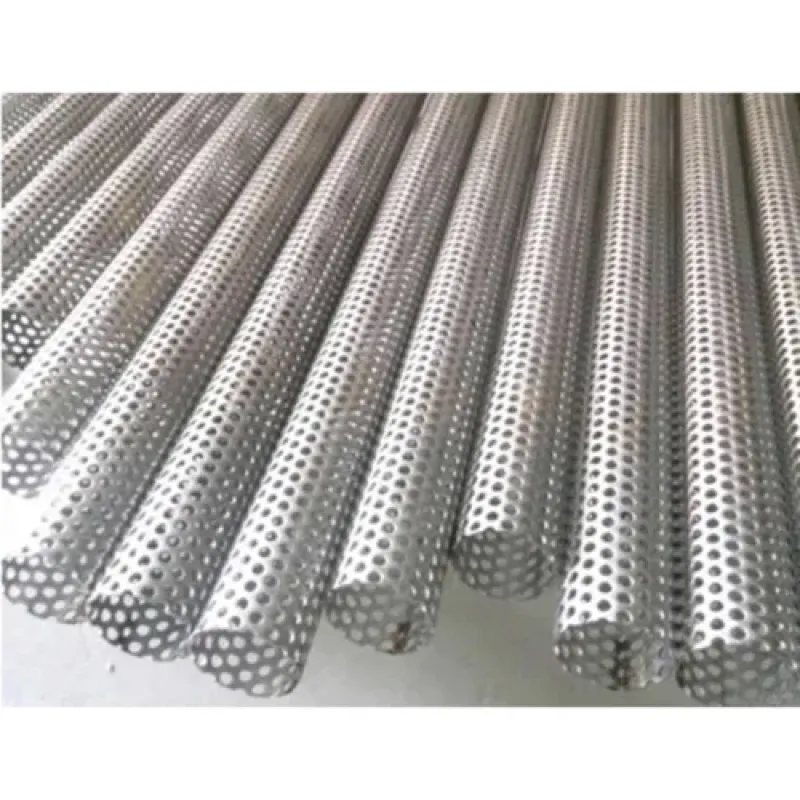
Siddhgiri Overseas manufactures Stainless Steel Perforated Tubes from our Mumbai facility, producing cylindrical tube sections with precisely punched holes that allow controlled passage of liquids, gases, air, light or sound while retaining the strength and corrosion resistance of stainless steel. Unlike standard pressure-carrying pipe, a perforated tube is engineered for filtration, ventilation, diffusion, drainage and acoustic control, with round, slotted, square, rectangular, hexagonal and staggered hole patterns available to suit the application. We manufacture in SS 304, 304L, 316, 316L, 409 and 410, with wall thicknesses from 1 mm to 3 mm and custom diameters, lengths and hole layouts, to standards including ASTM, ASME, DIN, EN and JIS. Established in 1962, Siddhgiri Overseas combines precision CNC punching with roll-forming, welding and finishing operations, backed by dimensional, weld-integrity and material testing before every dispatch.
A stainless steel perforated tube is a hollow cylindrical section formed from stainless steel sheet or coil that has had a precise pattern of holes punched into it before the material is roll-formed into a tube and welded along the seam. The perforations are sized, spaced and aligned to a controlled open-area ratio, so the finished tube delivers a specific, repeatable flow characteristic rather than simply containing whatever passes through it.
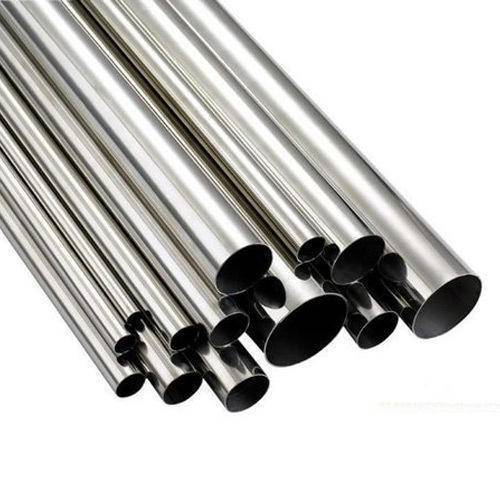
Perforated tube is a functionally different product from standard stainless steel pipe or tube. Standard tube is built to carry fluid under pressure with a solid, unbroken wall; perforated tube is built to let liquids, gases, air, heat or sound pass through the wall in a controlled way, and is not intended for pressurised fluid transport. Its role is filtering, separating, screening, diffusing, venting, draining or attenuating sound.
Common hole patterns
Siddhgiri Overseas manufactures perforated tube under strict quality control to hold consistent open-area ratios, accurate sizing and reliable in-service performance across every batch.

Producing a stainless steel perforated tube is a multi-stage process that combines precision punching with conventional tube-forming technology.
Material Selection
Production begins with stainless steel coil or sheet in the grade specified by the customer — commonly SS 304, 304L, 316, 316L, 409 or 410 — each offering a different balance of corrosion resistance, strength and cost.
Precision Perforation
Before the sheet is formed into a tube, it is perforated using CNC punching machines or precision perforation presses. Hole diameter, spacing, orientation and the resulting open-area ratio are all controlled according to the flow, filtration or ventilation performance the application requires.
Tube Forming
The perforated sheet is then roll-formed into a cylindrical shape on tube-forming equipment. The longitudinal edges are joined by welding, or by a spiral lock-seam construction where the design calls for it, while the alignment of the perforation pattern is maintained around and along the tube.
Finishing Operations
Finished tubes are straightened, deburred, cleaned and surface-finished to remove any burrs left by the punching operation and to improve appearance, hygiene and corrosion resistance. Bright polished, satin, matte, mill and custom finishes are all available.
Quality Inspection
Before dispatch, every batch is checked for dimensional accuracy, hole alignment, weld integrity, mechanical properties and corrosion resistance, along with a final visual inspection against the applicable standard.
The stainless steel grade selected for a perforated tube has a direct effect on its corrosion resistance, strength and suitability for a given environment.
|
SS 304 / 304L |
Good general corrosion resistance, strength and economical fabrication; 304L has lower carbon for improved weldability |
Food processing, agricultural filtration, architectural work, general industrial filtration |
|
SS 316 / 316L |
Molybdenum addition gives strong resistance to chlorides, acids, saltwater and aggressive chemicals |
Pharmaceutical plants, marine and offshore engineering, chemical processing, desalination |
|
SS 409 / 410 |
Heat-resistant with good mechanical properties |
Automotive exhaust systems, mufflers and silencers, industrial furnaces and other high-temperature service |
Perforated tube from Siddhgiri Overseas is used across a wide range of industries. In filtration and water treatment, tubes remove solids from liquids, protect pumps and act as filter elements in chemical plants and refineries. In the automotive sector, perforated tube forms the internal core of exhaust systems, mufflers and silencers, damping engine noise while allowing exhaust gases to flow freely. Diffusion applications use perforated tube to distribute air, steam, gases and vapours evenly through processing plants, wastewater treatment systems and aeration equipment. Architects specify perforated tube for decorative facades, safety guards, ventilation panels, machine enclosures, lighting fixtures and acoustic ceilings. It is also widely used in power generation, HVAC systems, agricultural processing, petrochemical plants, pharmaceutical equipment, paper mills and mining operations, wherever durability and corrosion resistance matter.
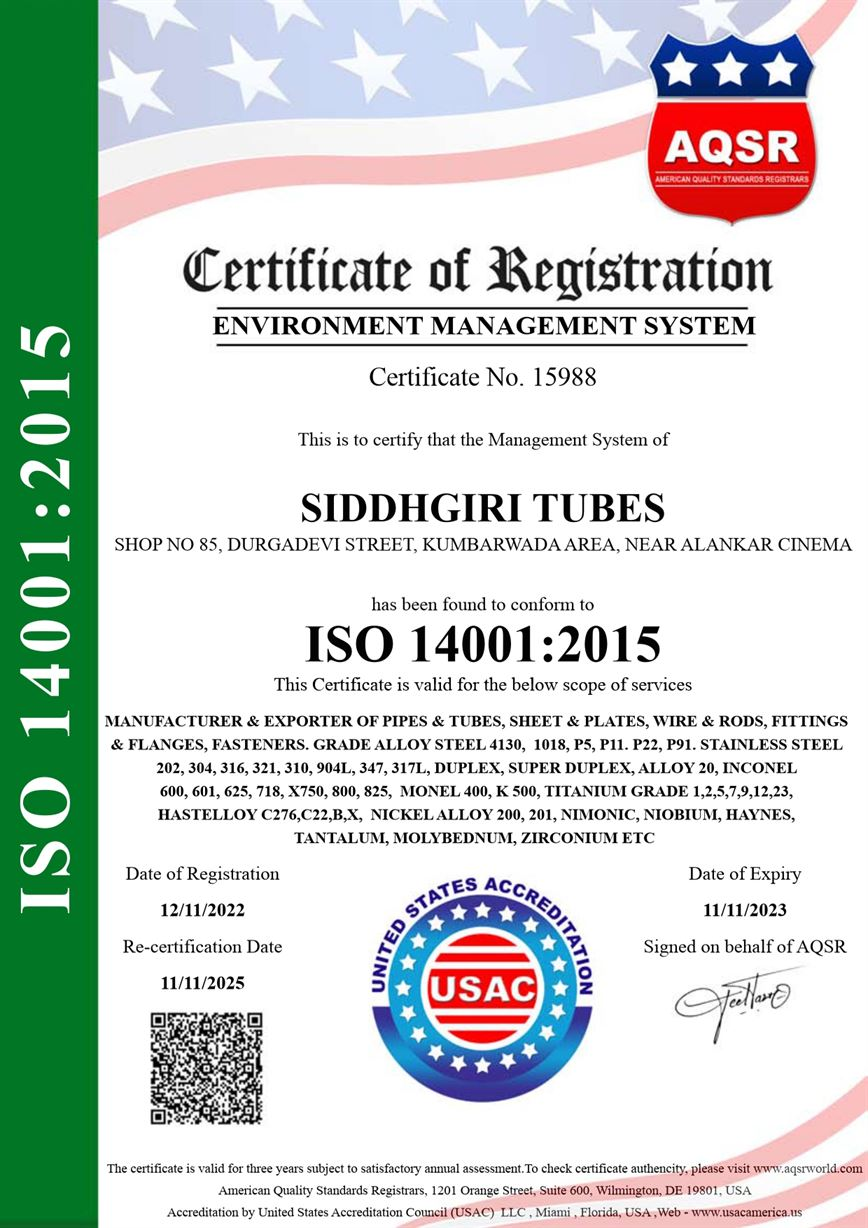
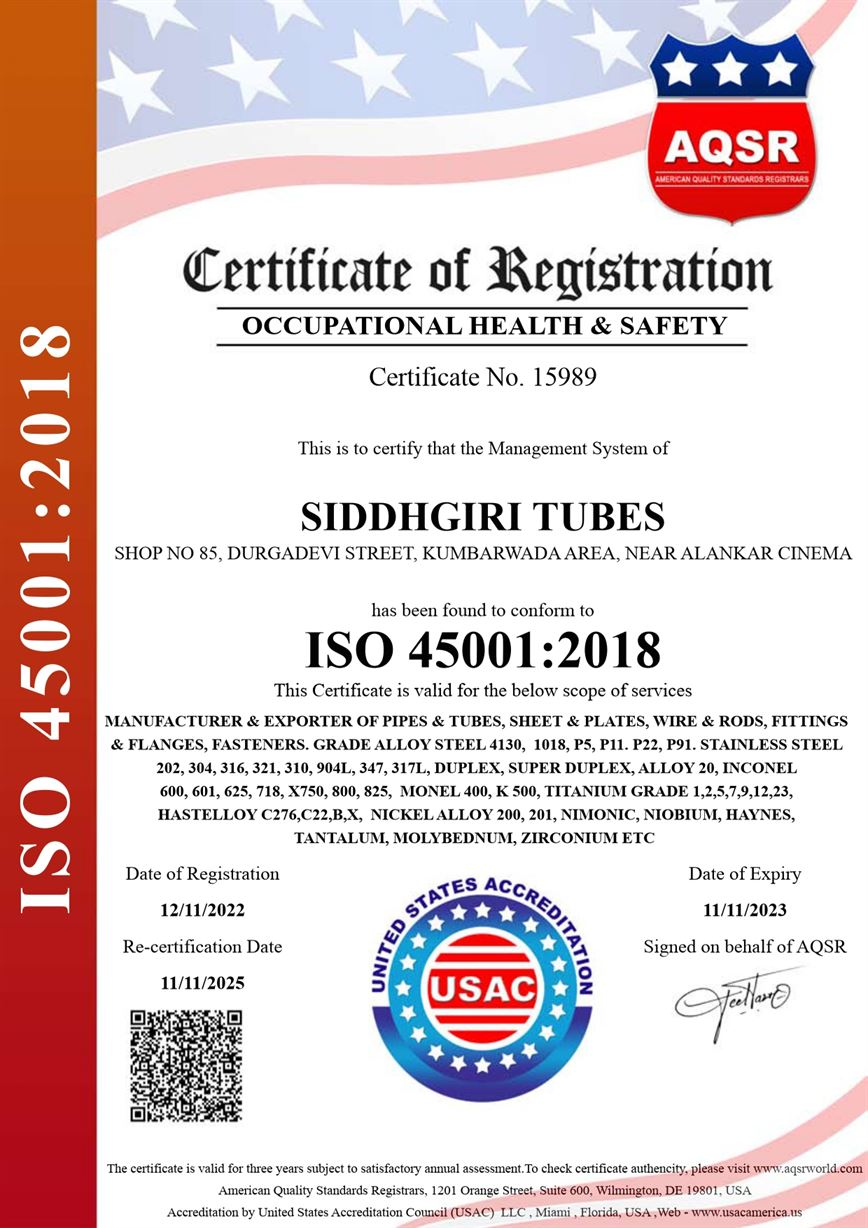
Siddhgiri Overseas is ISO certified for quality, occupational health & safety and environment management, and holds the import and export certification required to supply stainless steel pipe and tube to customers worldwide. Certificate copies are available on request for buyers who need them for their own compliance records.
It is a hollow cylindrical tube formed from stainless steel sheet or coil that has been punched with a precise pattern of holes before rolling and welding into tubular shape. The holes allow controlled passage of liquids, gases, air, light or sound while the tube retains the strength and corrosion resistance of stainless steel.
Standard pipe or tube is built with a solid, unbroken wall to carry fluid under pressure. Perforated tube is specifically engineered to let material pass through its wall in a controlled way and is not designed for pressurised fluid transport — its purpose is filtering, screening, diffusing, venting, draining or sound attenuation.
Siddhgiri Overseas produces perforated tube with round, slotted, square, rectangular, hexagonal and custom hole patterns, arranged in straight-line or staggered layouts. Round holes are the most common for their balanced strength and even flow; slotted patterns suit drainage and dewatering; square and rectangular patterns are chosen for architectural and decorative applications.
We manufacture perforated tube in SS 304 and 304L for general corrosion resistance and economical fabrication, SS 316 and 316L with added molybdenum for resistance to chlorides and aggressive chemicals, and SS 409 and 410 for heat-resistant applications such as automotive exhaust systems.
Our perforated stainless steel tubes are produced to meet ASTM, ASME, DIN, EN and JIS specifications as required by the project, with wall thicknesses ranging from 1 mm to 3 mm and custom diameters, lengths and hole configurations available.
Tube diameter and length are supplied to customer specification, with standard wall thicknesses of 1 mm to 3 mm and custom thicknesses on request. Surface finishes include bright polish, satin, matte and mill finish, selected according to the application.
Every batch undergoes dimensional inspection, hole alignment verification, weld integrity testing, mechanical property testing, corrosion resistance testing and visual inspection, confirming the tubes meet the applicable standard before leaving our facility.
Perforated tube is used in filtration and water treatment systems, automotive exhaust and muffler components, industrial diffusion and aeration equipment, architectural facades and ventilation panels, and across power generation, HVAC, pharmaceutical, petrochemical and mining applications where controlled flow and corrosion resistance are both required.