
What Should Engineers Check Before Buying 4130 Chromoly Tubes for Fabrication?
- Siddhgiri Overseas
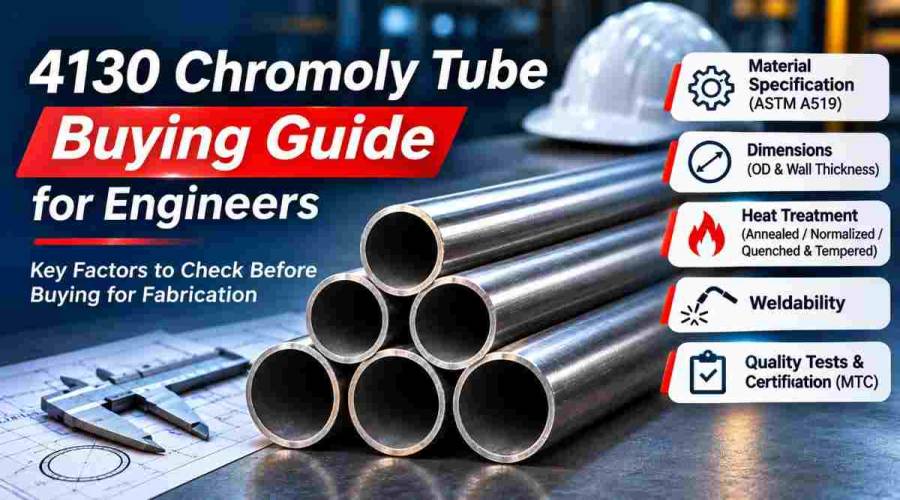
Choosing the right tubing for an engineering or fabrication project requires more than checking its diameter and price. Material grade, mechanical strength, wall thickness, manufacturing standards, and weldability all influence how a tube performs once it becomes part of a finished structure.
SAE 4130 chromoly tubing is widely used in motorsport, aerospace, bicycle manufacturing, and mechanical engineering because it offers a useful combination of strength, toughness, and weldability.
However, not every 4130 tube has identical mechanical properties. Differences in heat treatment, dimensional tolerances, and manufacturing processes can affect its suitability for a particular application.
This 4130 Chromoly Tube Buying Guide explains the essential factors engineers and procurement teams should evaluate before placing an order.
What Is 4130 Chromoly Tubing, and Why Is It Used in Fabrication?
4130 chromoly tubing is a low-alloy steel product containing chromium and molybdenum. These alloying elements contribute to its mechanical performance, making it suitable for structural components exposed to demanding operating conditions.
The designation 4130 identifies a chromium-molybdenum steel grade containing approximately 0.30% carbon.
Unlike stainless steel, chromoly tubing is primarily selected for mechanical strength and fabrication characteristics rather than high corrosion resistance.
Some of its important characteristics include:
-
High strength-to-weight potential when properly designed
-
Good toughness and fatigue performance when appropriately specified
-
Good weldability with suitable fabrication procedures
-
Ability to undergo heat treatment
-
Suitability for precision mechanical components
-
Versatility in structural and industrial applications
Engineers frequently consider 4130 chromoly tubing for applications where structural reliability and controlled weight are important.
Which Material Specifications Should Engineers Verify Before Buying 4130 Tubes?
Engineers should verify the steel grade, chemical composition, manufacturing standard, and material condition before purchasing 4130 tubing.
These details help establish whether the supplied material matches the requirements of the intended component.
What Is the Chemical Composition of 4130 Chromoly Steel?
4130 chromoly steel typically contains the following alloying elements:
-
Carbon: Approximately 0.28–0.33%
-
Chromium: Approximately 0.80–1.10%
-
Molybdenum: Approximately 0.15–0.25%
-
Manganese: Approximately 0.40–0.60%
-
Silicon: Approximately 0.15–0.35%
Chromium and molybdenum contribute to the material's hardenability and mechanical performance. Carbon content also influences hardness, strength, and weldability.
Buyers should request a material test certificate showing the actual chemical composition of the supplied batch.
The composition should be compared against the applicable material specification rather than relying exclusively on the supplier's product description.
Why Is ASTM A519 Important for 4130 Tubing?
ASTM A519/A519M is a specification covering seamless carbon and alloy steel mechanical tubing, including grade 4130.
It addresses requirements relating to material composition, manufacturing, dimensions, and other applicable conditions.
When ordering ASTM A519 4130 tubing, engineers should confirm:
-
The applicable standard and edition
-
SAE 4130 material designation
-
Hot-finished or cold-finished manufacturing condition
-
Outside diameter and wall thickness
-
Required dimensional tolerances
-
Heat treatment condition
-
Additional inspection or mechanical testing requirements
ASTM A519 does not automatically establish every application-specific strength, fatigue, or impact requirement. These should be stated separately when the project requires them.
How Should Engineers Select the Correct Outside Diameter and Wall Thickness?
Engineers should choose tubing dimensions based on structural calculations, loading conditions, fabrication methods, and any applicable design standards.
A tube's outside diameter affects bending stiffness and its resistance to certain structural loads. Wall thickness influences load capacity, local buckling resistance, overall weight, and fabrication behavior.
For example, a lightweight frame may benefit from a larger-diameter tube with a carefully selected wall thickness, depending on the required stiffness and strength.
Before ordering, buyers should establish:
-
The required outside diameter (OD)
-
Nominal and minimum acceptable wall thickness
-
Length and cutting tolerance
-
Permitted ovality and straightness
-
Dimensional tolerances after bending or machining
-
Required surface condition
For precision applications, engineers should also evaluate the internal diameter and wall thickness uniformity.
Choosing a thinner wall solely to reduce weight can introduce risks if buckling, fatigue, impact loading, or weld-joint performance have not been assessed.
Should Engineers Choose Seamless or Cold-Drawn 4130 Tubing?
Seamless and cold-drawn are not competing material categories. Seamless describes how the tube is initially manufactured, while cold drawing is a finishing process that may be applied to seamless tubing.
Seamless tubing is manufactured without a longitudinal welded seam. It is commonly selected for demanding mechanical applications where tube integrity and consistent material characteristics are important.
Cold drawing can improve dimensional accuracy, surface finish, and concentricity.
Cold-drawn tubing may be particularly useful for:
-
Precision chassis components
-
Mechanical assemblies requiring tight dimensional tolerances
-
Components undergoing further machining
-
Applications requiring consistent outside diameter
-
Fabricated structures requiring accurate fit-up
However, cold working can also affect mechanical properties and residual stresses.
Buyers should therefore confirm whether the supplied tube has been annealed, normalized, stress relieved, or otherwise heat treated after processing.
Why Does Heat Treatment Matter When Purchasing 4130 Tubes?
Heat treatment affects the strength, hardness, toughness, ductility, and fabrication behavior of 4130 tubing.
Material supplied in different conditions may perform differently despite having the same chemical composition.
What Is Normalized 4130 Tubing?
Normalized 4130 tubing has undergone a controlled heating and cooling process designed to refine its microstructure and establish a suitable combination of mechanical properties.
Normalized material is commonly considered for structural fabrication because it offers a useful balance of strength, toughness, and ductility.
When Is Annealed 4130 Tubing Preferred?
Annealed 4130 tubing is generally selected when improved machinability, formability, or reduced hardness is required.
It can be useful for components that will undergo substantial machining or forming before final processing.
When Should Quenched-and-Tempered Tubing Be Considered?
Quenched-and-tempered 4130 tubing may be specified when a particular combination of increased strength, hardness, and toughness is required.
The resulting properties depend on the heat treatment procedure and section dimensions.
Engineers should never assume that annealed, normalized, and quenched-and-tempered tubing are mechanically interchangeable.
The required material condition should appear clearly on the purchase order and supporting documentation.
How Can Engineers Evaluate the Weldability of 4130 Chromoly Tubes?
4130 chromoly steel is generally weldable, but the welding procedure must be compatible with the tube's material condition, thickness, joint design, and intended service.
TIG welding is commonly used for precision chromoly fabrication. Other welding processes may also be suitable when properly qualified.
Important factors include:
-
Appropriate filler material
-
Joint preparation and fit-up
-
Heat input and cooling rate
-
Preheating requirements
-
Potential heat-affected-zone hardening
-
Post-weld heat treatment requirements
-
Inspection of completed joints
Thin-wall structural tubing and heavy-wall mechanical tubing may require different welding procedures.
For highly stressed or safety-critical structures, welding should follow a qualified procedure and the applicable engineering or industry requirements.
Manufacturers should also consider how welding may alter the properties established by the original heat treatment.
What Quality Tests Should Buyers Request for 4130 Tubing?
Buyers should request inspection and testing records appropriate to the material specification and the intended application.
Testing helps verify material identity, dimensional conformity, mechanical performance, and the absence of unacceptable defects.
Why Is Chemical Composition Testing Important?
Chemical analysis verifies whether the supplied material meets the composition requirements for SAE 4130.
A material test certificate should document the relevant heat analysis results.
Additional product analysis may be necessary when the project specification or quality plan requires it.
What Does Tensile Testing Confirm?
Tensile testing measures mechanical characteristics such as yield strength, ultimate tensile strength, and elongation.
These results help engineers determine whether the material meets specified strength and ductility requirements.
Mechanical properties should be evaluated against the ordered heat treatment condition and agreed acceptance criteria.
Why Are Hardness and Ultrasonic Tests Useful?
Hardness testing helps assess material consistency and can support verification of the specified heat treatment condition.
Ultrasonic testing can identify certain internal discontinuities, depending on the inspection method and the geometry of the tube.
Neither test should be treated as a substitute for every other required examination.
At Siddhgiri Overseas, quality verification includes chemical analysis, dimensional checks, mechanical testing, and other inspections appropriate to the product and specification.
Buyers can review the company's quality and certification procedures before placing an order.
What Surface Finish and Corrosion Protection Should Be Considered?
4130 chromoly tubing does not provide the same corrosion resistance as stainless steel.
Its relatively low chromium content means additional corrosion protection may be necessary, particularly where components are exposed to moisture, chemicals, or outdoor conditions.
Depending on the application, suitable protective measures may include:
-
Painting or powder coating
-
Protective oil during storage
-
Appropriate industrial coatings
-
Controlled storage and transportation conditions
-
Regular inspection and maintenance
Any coating must be compatible with the intended service environment and fabrication process.
For example, components that will undergo welding may require coating removal around the joint before fabrication.
Engineers should also consider whether the finished component will be exposed to elevated temperatures or corrosive substances.
Where Is 4130 Chromoly Tubing Commonly Used?
4130 chromoly tubing is used in engineering applications where the combination of strength, toughness, fabrication characteristics, and potential weight savings is valuable.
Why Is 4130 Tubing Used in Motorsport?
Motorsport applications include roll cages, chassis structures, suspension components, and other fabricated assemblies.
These components often experience vibration, impact, and repeated loading.
Material selection must account for the relevant motorsport regulations, approved tubing dimensions, and fabrication requirements.
Why Is 4130 Tubing Used in Aerospace Engineering?
4130 steel has a long history of use in aircraft structural components, including certain fuselage structures and engine mounts.
Aerospace applications require strict attention to material traceability, approved specifications, manufacturing processes, and inspection requirements.
An ASTM A519 designation alone should not be assumed to meet the requirements of a particular aircraft application.
How Is 4130 Tubing Used in Bicycle Manufacturing?
4130 chromoly tubing is used in bicycle frames and related components because designers can balance structural strength, stiffness, fatigue performance, and frame weight.
Tube diameter, wall thickness, joint design, and fabrication quality all influence the performance of the finished bicycle frame.
Is 4130 Tubing Suitable for Industrial Machinery?
Yes. When appropriately engineered, 4130 tubing can be used in mechanical assemblies, equipment structures, and load-bearing components.
The correct material condition and dimensions depend on operating loads, environmental exposure, and the relevant equipment specifications.
What Documents Should Engineers Request Before Ordering 4130 Chromoly Tubes?
Engineers should request documentation that confirms both material identity and conformity with the purchase specification.
Important documents may include:
-
Mill Test Certificate (MTC)
-
Chemical composition report
-
Mechanical test results
-
Heat treatment records
-
Dimensional inspection report
-
Non-destructive testing reports, where specified
-
Material traceability information
-
Applicable third-party inspection documentation
The material heat number should match the supplied certificate wherever heat traceability is required.
Buyers should also confirm any additional certification requirements before manufacturing begins, rather than requesting them after the material is ready for dispatch.
What Common Mistakes Should Buyers Avoid When Purchasing 4130 Tubing?
The most common purchasing mistakes involve treating all 4130 tubing as equivalent without checking its dimensions, material condition, or documentation.
These mistakes can lead to fabrication delays, incorrect material selection, or unnecessary replacement costs.
Avoid the following issues:
-
Purchasing by price without verifying material certification
-
Confusing 4130 chromoly steel with stainless steel
-
Assuming all heat treatment conditions provide identical strength
-
Ordering the wrong outside diameter or wall thickness
-
Ignoring dimensional tolerances required for fabrication
-
Selecting tubing without considering the welding procedure
-
Overlooking corrosion protection requirements
-
Failing to verify material traceability
A detailed purchase specification can reduce these risks and make quotations easier to compare.
How Should Engineers Prepare a 4130 Chromoly Tube Purchase Inquiry?
A purchase inquiry should clearly describe the material, dimensions, required condition, testing requirements, and delivery expectations.
For an efficient quotation process, engineers should provide:
-
Material grade: SAE 4130
-
Manufacturing standard: ASTM A519/A519M or another required specification
-
Outside diameter and wall thickness
-
Required quantity and lengths
-
Heat treatment condition
-
Dimensional tolerances
-
Required mechanical properties
-
Inspection and certification requirements
-
Surface finish or protective coating
-
Delivery location and schedule
Providing complete technical details helps suppliers determine whether the required material is available and suitable for the intended project.
Frequently Asked Questions About 4130 Chromoly Tubing
Is 4130 Chromoly Stronger Than Mild Steel?
4130 chromoly steel can provide higher strength than many conventional mild steels, depending on its heat treatment and material condition. However, the comparison should be based on certified mechanical properties rather than grade names alone.
Can 4130 Chromoly Tubing Be Bent Without Cracking?
Yes, 4130 tubing can be bent using suitable equipment and procedures. Bend radius, wall thickness, material condition, and tooling affect the risk of cracking, flattening, or wrinkling.
Does 4130 Chromoly Tubing Require Heat Treatment After Welding?
Not always. The need for post-weld heat treatment depends on the material condition, component thickness, welding procedure, operating requirements, and applicable design standards.
Is ASTM A519 4130 Tubing Suitable for Structural Fabrication?
ASTM A519 4130 tubing can be suitable for structural fabrication when its dimensions, mechanical properties, heat treatment condition, and other requirements meet the relevant engineering specification.
What Is the Difference Between 4130 and 4140 Chromoly Tubing?
4130 generally contains less carbon than 4140, making it a common choice where weldability and structural fabrication are important. 4140 is often selected for applications requiring greater hardenability, wear resistance, or strength after appropriate heat treatment.
Where Can Engineers Source 4130 Chromoly Tubes for Fabrication?
Engineers should choose a supplier that can provide the required tubing specifications, material traceability, quality documentation, and reliable order coordination.
Siddhgiri Overseas, based in Mumbai, India, supplies chromoly tubing for engineering, fabrication, and industrial applications.
The company's product range includes SAE 4130 chromoly tubing, with manufacturing and inspection requirements aligned to applicable standards.
Buyers can explore the available chromoly tube range and share their project specifications for confirmation of availability.
Request a Quote for 4130 Chromoly Tubing
Selecting the correct tubing begins with a clear understanding of the required material grade, wall thickness, heat treatment, and fabrication conditions.
Contact Siddhgiri Overseas with your technical specifications, quantity, and delivery requirements to request a quotation for your next engineering or fabrication project.