
How to Check Stainless Steel Pipe Quality Before Buying? 8 Important Tests
- Siddhgiri Overseas

Purchasing stainless steel pipes for industrial applications involves more than comparing prices, sizes, and material grades. The quality of the pipes can influence their performance, corrosion resistance, dimensional accuracy, and suitability for the intended operating conditions.
Whether you are sourcing pipes for chemical processing, manufacturing, construction, or industrial fluid-handling systems, understanding stainless steel pipe quality testing can help you avoid incorrect materials, specification mismatches, and unnecessary project delays.
But how do you verify that a stainless steel pipe meets the required specifications before placing a bulk order?
At Siddhgiri Overseas, we manufacture and supply stainless steel pipes and tubes for industrial and engineering applications. Our quality process includes material verification, dimensional inspection, and applicable testing requirements based on the product specification.
This guide explains eight important stainless steel pipe inspection methods, how to verify material documentation, and what industrial buyers should check before purchasing.
Why Is Stainless Steel Pipe Quality Testing Important?
Stainless steel pipes are used in applications where material performance, dimensional precision, and reliability are important.
Depending on the application, pipes may be exposed to internal pressure, temperature changes, mechanical loads, corrosive fluids, or demanding installation conditions.
Using material that does not meet the required specifications can create problems such as:
- Premature corrosion or material deterioration.
- Incorrect pipe fitment during installation.
- Leakage caused by material or manufacturing defects.
- Unexpected maintenance and replacement expenses.
- Project delays due to rejected material.
- Failure to meet applicable engineering specifications.
Proper stainless steel pipe inspection helps verify whether the supplied material conforms to the requirements of the purchase order and applicable standards.
Different tests evaluate different characteristics, so no single inspection method can establish every aspect of pipe quality.
What Are the 8 Most Important Stainless Steel Pipe Quality Tests?
The following tests and inspection methods are commonly considered when evaluating stainless steel pipes for industrial applications.
The exact combination depends on the pipe grade, manufacturing process, product standard, purchase specification, and intended service.
1. Visual Inspection: How Do You Identify Surface Defects?
Visual inspection is one of the first steps in checking stainless steel pipe quality.
Inspectors examine the external and accessible internal surfaces for visible imperfections that may affect manufacturing compliance or suitability for use.
Common issues to check include:
- Visible cracks or surface discontinuities.
- Dents and mechanical damage.
- Deep scratches or gouges.
- Unacceptable surface irregularities.
- Signs of contamination or corrosion.
- Visible weld-seam imperfections.
- Damaged or poorly prepared pipe ends.
Surface finish requirements vary depending on the application. A decorative or hygienic pipe may require a different finish from an industrial process pipe.
Visual inspection is important, but it cannot reliably identify hidden internal defects or confirm chemical composition.
Siddhgiri Overseas includes visual and surface-finish checks within its published quality inspection process.
2. Dimensional Inspection: How Do You Check Pipe Size and Wall Thickness?
Dimensional inspection verifies whether the pipe meets the specified size and tolerance requirements.
Even when the correct stainless steel grade is supplied, incorrect dimensions may cause installation problems or make the pipe unsuitable for the approved engineering design.
Important measurements include:
- Outside diameter (OD).
- Wall thickness.
- Overall pipe length.
- Straightness.
- Ovality where applicable.
- Pipe-end dimensions and preparation.
Common inspection instruments include vernier calipers, micrometers, measuring tapes, and specialized wall-thickness gauges.
For stainless steel pipes specified by nominal pipe size and schedule, dimensions should be checked against the applicable dimensional standard.
The stainless steel pipe size and schedule chart can help buyers identify relevant nominal dimensions before confirming a purchase.
Inspectors must also consider permitted manufacturing tolerances rather than assuming every measured value will exactly match the nominal dimension.
3. Positive Material Identification: How Do You Verify SS 304 and SS 316 Grades?
Positive Material Identification (PMI) is used to evaluate the elemental composition of metallic materials.
It is particularly useful when verifying whether delivered stainless steel pipes match the grade specified in the purchase order.
For example, SS 304 and SS 316 are both commonly used austenitic stainless steels, but their chemical compositions and corrosion-resistance characteristics differ.
SS 316 generally contains molybdenum, which helps improve resistance to certain forms of localized corrosion in chloride-containing environments.
PMI may be performed using techniques such as:
- X-ray fluorescence (XRF) analysis.
- Optical emission spectroscopy (OES).
XRF is useful for identifying many alloying elements, but conventional handheld XRF generally cannot measure carbon reliably. Therefore, additional testing may be necessary when distinguishing low-carbon grades such as 304L and 316L.
PMI is an important verification method, but it should not automatically be treated as a complete replacement for a certified laboratory chemical analysis.
Buyers can explore the SS 304 stainless steel pipe and SS 316 stainless steel pipe product ranges when comparing material options.
4. Hydrostatic Testing: How Are Stainless Steel Pipes Checked for Leakage?
Hydrostatic testing is a pressure test commonly used to check the integrity of piping products.
During the test, the pipe is filled with a suitable liquid, typically water, and subjected to a specified test pressure under controlled conditions.
The pipe is examined according to the applicable test procedure and acceptance criteria.
Hydrostatic testing may help identify defects that allow leakage under the test conditions.
However, it does not establish the absence of every possible defect or guarantee suitability for every operating pressure.
According to ASTM A312/A312M, covered austenitic stainless steel pipes are generally subject to hydrostatic testing or nondestructive electric testing, subject to the specification's requirements and permitted exceptions.
The applicable testing method and any additional purchaser requirements should be confirmed before ordering.
Hydrostatic testing should be conducted by trained personnel using suitable equipment and approved procedures.
5. Ultrasonic Testing: How Are Internal Pipe Defects Detected?
Ultrasonic testing (UT) is a nondestructive examination method that uses high-frequency sound waves to inspect materials.
It can be used to detect certain internal or surface-connected discontinuities, depending on the inspection technique, equipment, and test configuration.
During ultrasonic inspection, a transducer sends sound waves into the material.
Reflections and other signal responses are analyzed to identify indications that may require evaluation against the applicable acceptance criteria.
Ultrasonic testing can be useful for:
- Evaluating selected internal discontinuities.
- Examining pipe-wall integrity.
- Inspecting certain welded or seamless products.
- Supporting quality verification without damaging the material.
However, the ability to detect defects depends on factors such as geometry, defect orientation, material condition, and the testing method used.
UT should be performed according to an appropriate examination procedure by qualified personnel.
For applications requiring seamless construction, buyers can review the stainless steel seamless pipe range.
6. Eddy Current Testing: How Are Surface and Near-Surface Defects Identified?
Eddy current testing is another nondestructive testing method used for electrically conductive materials, including stainless steel.
It works through electromagnetic induction.
Changes in the electromagnetic response can indicate discontinuities or other differences in material characteristics.
Eddy current examination may be used to inspect pipes and tubes for certain surface or near-surface defects.
Potential inspection applications include:
- Identifying selected surface discontinuities.
- Detecting certain near-surface imperfections.
- Supporting automated production inspection.
- Checking tubular products under applicable testing procedures.
The results depend on the equipment, inspection frequency, calibration, material properties, and defect characteristics.
Eddy current testing does not automatically detect every type of defect, and its suitability should be evaluated against the specified inspection requirements.
For general requirements applicable to many alloy and stainless steel pipes, refer to ASTM A999/A999M.
7. Mechanical Testing: How Do You Verify Pipe Strength and Ductility?
Mechanical testing evaluates whether stainless steel material meets specified mechanical-property requirements.
Depending on the applicable product standard, testing may include tensile tests, flattening tests, or other required examinations.
Tensile testing is used to determine properties such as tensile strength, yield strength, and elongation.
These values help establish whether the material meets the mechanical requirements of the specified grade and product standard.
Flattening testing may be used to evaluate the behavior of tubular material under deformation and to identify certain material or manufacturing issues.
For austenitic stainless steel pipes covered by ASTM A312, mechanical test requirements depend on the material grade, product form, and applicable specification provisions.
Mechanical testing is particularly important when the pipe will be used in engineered systems where material-property compliance must be documented.
Buyers should request the relevant mechanical test results as part of the required material documentation.
8. Chemical Composition Testing: How Do You Confirm Stainless Steel Quality?
Chemical composition testing determines the elemental content of the stainless steel material.
Stainless steel grades are defined partly by specified chemical composition ranges.
Depending on the grade, important elements may include:
- Chromium.
- Nickel.
- Molybdenum.
- Carbon.
- Manganese.
- Silicon.
- Phosphorus.
- Sulfur.
- Nitrogen, where specified.
For example, chromium is a key element responsible for the passive corrosion-resistant behavior of stainless steel.
Molybdenum contributes to the improved localized corrosion resistance of certain grades, including SS 316.
Chemical analysis results should be checked against the ordered material grade and applicable product standard.
The material's heat or batch identification should also be traceable to the corresponding test documentation.
What Is a Mill Test Certificate for Stainless Steel Pipes?
A Mill Test Certificate (MTC) is an important document used in stainless steel material procurement.
It records information about the material and relevant inspection or test results associated with its production.
Depending on the certificate type and applicable requirements, an MTC may include:
- Manufacturer details.
- Material grade and specification.
- Heat or batch number.
- Product dimensions.
- Chemical composition results.
- Mechanical test results.
- Relevant inspection or testing information.
- Authorized inspection or validation details.
One commonly requested inspection document is the EN 10204 Type 3.1 certificate.
Buyers should understand that EN 10204 defines inspection document types rather than replacing the applicable material product standard.
Siddhgiri Overseas provides further information about documentation requirements on its Mill Test Certificates and EN 10204 3.1 page.
How Can You Verify Whether a Mill Test Certificate Is Genuine?
A certificate should not be accepted solely because it contains technical values and an official-looking format.
Buyers should verify that the information matches the material supplied.
Before accepting an MTC, check the following:
- Does the manufacturer's identity match the supplied documentation?
- Does the material grade match the purchase order?
- Is the heat number traceable to the pipe markings?
- Are the dimensions and specifications correct?
- Are the chemical results within the required limits?
- Do the mechanical results meet the applicable specification?
- Is the certificate type consistent with the purchase requirements?
- Can the supplier or issuing manufacturer confirm its authenticity when necessary?
If the supplied pipe markings do not match the certificate's heat or batch details, request clarification before accepting the material.
For projects with stringent traceability requirements, maintain the relevant documentation throughout storage, fabrication, and installation.
Which ASTM Standards Apply to Stainless Steel Pipe Quality Testing?
Different stainless steel products are manufactured and inspected under different technical standards.
Two commonly relevant specifications include ASTM A312/A312M and ASTM A999/A999M.
ASTM A312/A312M: Austenitic Stainless Steel Pipes
ASTM A312/A312M covers seamless, welded, and heavily cold-worked austenitic stainless steel pipes intended for high-temperature and general corrosive service.
The specification includes requirements relating to chemical composition, heat treatment, mechanical properties, and testing.
It is commonly associated with pipe grades such as TP304, TP304L, TP316, and TP316L.
ASTM A999/A999M: General Pipe Requirements
ASTM A999/A999M establishes general requirements for alloy and stainless steel pipes covered by applicable product specifications.
It addresses various requirements concerning dimensions, inspection, testing, and other manufacturing considerations.
Buyers should always confirm the edition and exact standards specified in the purchase order or engineering documentation.
How Do You Verify the Quality of SS 304 and SS 316 Stainless Steel Pipes?
SS 304 and SS 316 are widely used stainless steel grades, but they should not be treated as interchangeable for every application.
SS 304 is commonly selected for general industrial, fabrication, and engineering applications where its corrosion resistance is appropriate.
SS 316 contains molybdenum and generally offers better resistance to certain chloride-related corrosion conditions.
When inspecting either grade, confirm:
- The correct material designation.
- Compliance with applicable chemical composition limits.
- Required mechanical properties.
- Specified pipe dimensions and tolerances.
- Surface condition and manufacturing quality.
- Required testing and material documentation.
For more product information, explore the SS 304 Pipe and SS 316 Pipe pages.
When low-carbon grades such as 304L and 316L are required, confirm the carbon-content specification through an appropriate chemical analysis rather than relying only on ordinary handheld XRF results.
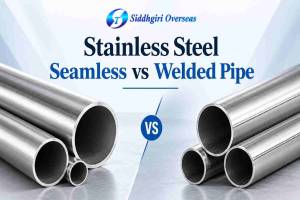
Does Stainless Steel Pipe Quality Testing Differ for Seamless and Welded Pipes?
Both seamless and welded stainless steel pipes require appropriate material verification, dimensional checks, and inspection.
However, manufacturing methods introduce different characteristics that may affect inspection requirements.
Quality Inspection for Seamless Stainless Steel Pipes
Seamless pipes are manufactured without a longitudinal welded seam.
Depending on the relevant product standard, inspection may include:
- Dimensional verification.
- Surface examination.
- Chemical analysis.
- Mechanical testing.
- Hydrostatic or nondestructive examination.
The absence of a longitudinal seam does not mean that seamless pipes are automatically free from manufacturing defects.
Explore Siddhgiri Overseas' stainless steel seamless pipe range for further product specifications.
Quality Inspection for Welded Stainless Steel Pipes
Welded pipes are produced by forming material into a tubular shape and joining the edges using a welding process.
In addition to general material and dimensional checks, applicable inspection procedures may include examination of the weld seam.
Weld-related inspection requirements depend on the manufacturing specification and intended application.
Properly manufactured welded pipes can meet demanding industrial specifications when qualified and tested according to the applicable requirements.
For further details, visit the stainless steel welded pipe product page.
Can You Check Stainless Steel Pipe Quality Without Laboratory Testing?
Some basic checks can be performed during receiving inspection without sending material to a laboratory.
These include:
- Checking pipe markings.
- Comparing the purchase order with delivery documents.
- Measuring outside diameter and wall thickness.
- Inspecting visible surface condition.
- Checking pipe lengths and quantities.
- Verifying heat numbers against the supplied MTC.
However, basic visual or dimensional inspection cannot conclusively establish the chemical composition or all mechanical properties of the material.
A magnet test, for example, is not a reliable way to distinguish all stainless steel grades. Austenitic stainless steels may show different levels of magnetic response depending on composition and cold working.
For material-grade confirmation, mechanical-property verification, or hidden-defect detection, use appropriate certified test results and qualified inspection methods.
What Should Buyers Check Before Ordering Stainless Steel Pipes?
Before placing an industrial order, prepare a complete technical specification.
A useful stainless steel pipe inspection checklist should include:
- Material Grade: Specify the required stainless steel grade, such as 304, 304L, 316, or 316L.
- Product Standard: Confirm the applicable ASTM, ASME, or other specified requirements.
- Dimensions: State the outside diameter, nominal pipe size, wall thickness, or schedule.
- Manufacturing Method: Specify seamless or welded construction.
- Surface Finish: Confirm any required mill, pickled, polished, or other finish.
- Testing Requirements: Identify mandatory and additional inspections.
- Material Documentation: Specify the required certificate type and traceability.
- Quantity and Delivery: Confirm order volume, length requirements, and delivery location.
These details help suppliers provide accurate quotations and reduce the risk of specification mismatches.
For larger or critical projects, inspection and documentation requirements should be finalized before production or dispatch.
Why Is Choosing a Quality-Focused Stainless Steel Pipe Supplier Important?
Working with a knowledgeable supplier can help buyers understand the differences between material grades, dimensions, manufacturing methods, and inspection requirements.
At Siddhgiri Overseas, our stainless steel pipe and tube range supports industrial, engineering, fabrication, and process applications.
Our published quality and certifications information covers:
- Dimensional inspection.
- Positive Material Identification.
- Hydrostatic and applicable nondestructive testing.
- Surface-finish examination.
- Final visual inspection.
- Material documentation and Mill Test Certificates.
Testing requirements vary by product and applicable standard, so buyers should confirm the inspections required for their particular order.
When requesting a quotation, share your technical specifications, certification requirements, quantity, and intended application.
Frequently Asked Questions About Stainless Steel Pipe Quality Testing
What Is the Most Important Test for Stainless Steel Pipes?
No single test establishes every aspect of stainless steel pipe quality. Chemical analysis verifies composition, dimensional inspection confirms size, mechanical testing evaluates specified properties, and hydrostatic or nondestructive examination addresses particular integrity requirements.
How Can I Check Whether a Pipe Is SS 304 or SS 316?
Review the material certificate and heat-number traceability. Positive Material Identification can help distinguish the grades through alloying elements such as molybdenum. Appropriate chemical analysis should be used when more detailed verification is necessary.
What Is PMI Testing in Stainless Steel Pipes?
PMI stands for Positive Material Identification. It evaluates alloy composition using analytical techniques such as XRF or OES to help verify whether the material matches the specified grade.
Is Hydrostatic Testing Mandatory for Stainless Steel Pipes?
Requirements depend on the product specification and purchase order. ASTM A312 generally requires hydrostatic testing or nondestructive electric testing, subject to specified provisions and permitted exceptions. Hydrostatic testing is not universally mandatory for every stainless steel pipe product.
What Is the Purpose of Ultrasonic Testing?
Ultrasonic testing uses sound waves to identify certain material discontinuities without damaging the inspected product. Its effectiveness depends on the inspection procedure, material geometry, equipment, and defect characteristics.
What Does an EN 10204 3.1 Certificate Mean?
An EN 10204 Type 3.1 inspection certificate provides specific inspection results and a statement of compliance with the order, validated by the manufacturer's authorized inspection representative who is independent of the manufacturing department.
Can Stainless Steel Pipes Pass Visual Inspection but Fail Other Tests?
Yes. A pipe may look acceptable while having incorrect chemical composition, insufficient wall thickness, nonconforming mechanical properties, or internal discontinuities that are not visible during a surface inspection.
Does a Higher Pipe Schedule Mean Better Pipe Quality?
No. A higher schedule generally indicates a thicker nominal wall for the same pipe size. Pipe quality depends on material conformity, manufacturing, testing, dimensional accuracy, and other specified requirements.
Should Buyers Request an MTC for Every Stainless Steel Pipe Order?
For industrial procurement, requesting an appropriate Mill Test Certificate is a useful practice, particularly where material traceability and technical compliance are important. The exact certificate type should match project and purchase-order requirements.
Final Thoughts
Understanding stainless steel pipe quality testing helps engineers, contractors, and procurement professionals make more informed purchasing decisions.
Visual inspection, dimensional verification, PMI, hydrostatic testing, ultrasonic inspection, eddy current testing, mechanical testing, and chemical analysis each play different roles in evaluating material conformity.
However, not every test is mandatory for every product. The required inspection process depends on the material specification, manufacturing method, operating conditions, and project requirements.
Before purchasing, verify the material grade, dimensions, applicable standards, Mill Test Certificate details, and any additional inspection requirements.
Whether you need seamless stainless steel pipes, welded stainless steel pipes, or specific grades for industrial applications, Siddhgiri Overseas can help you review your purchasing specifications.
For product details, material documentation requirements, and quotations, contact Siddhgiri Overseas and share your project requirements.