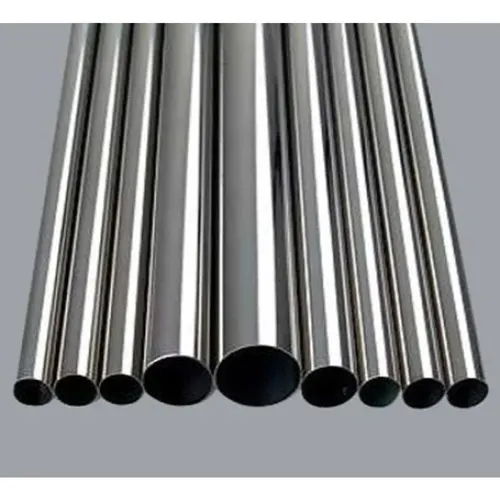
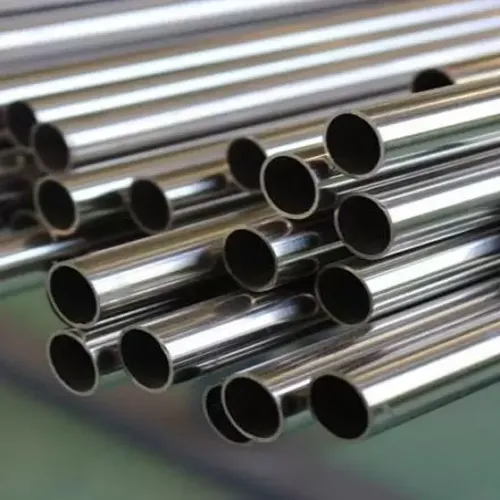
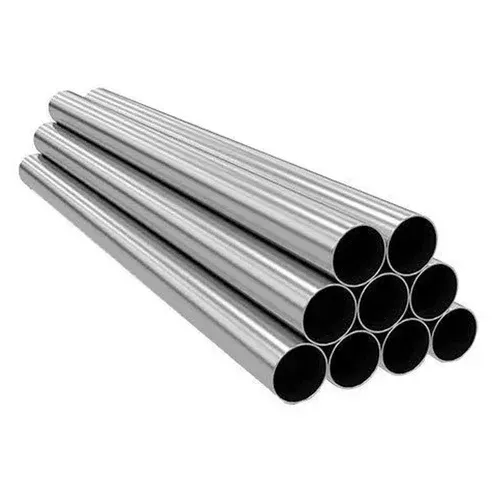
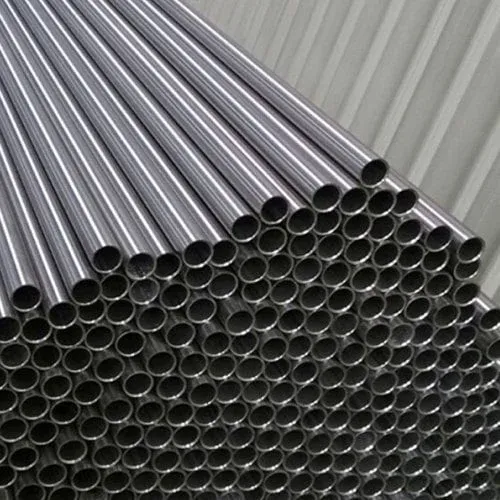
Siddhgiri Overseas manufactures stainless steel pipe in Mumbai across the austenitic grades, and supplies buyers in Johor Bahru. In production since 1962.
This page is a selection guide rather than a product listing. Choosing the grade wrong is the single most expensive decision in a piping package: specify below the duty and the line fails early, specify above it and you pay for alloy that does nothing. Each grade below links to its own page.
Buyers usually open with "is 304 enough or should we go 316". That is the third question, not the first.
1. Are chlorides present? Seawater, brine, chlorinated water, coastal air, many process chemicals and most food brines. Chloride decides molybdenum, and molybdenum is the difference between the 304 family and the 316 family.
2. Will it be welded, and then left unannealed? If yes, the carbon ceiling decides. Standard-carbon grades sensitise in the weld heat affected zone; low-carbon grades do not.
3. How hot, and for how long? Brief excursions are one thing. Sustained service above roughly 425 °C is another, and it moves you to the stabilised grades.
4. Is there hydrogen sulphide? If so, NACE MR0175 governs the selection and the standard austenitic grades may not qualify at all. That is a process engineering decision before it is a purchasing one.
| Grade | Cr / Ni / Mo | Carbon max | Chosen for | Not for |
|---|---|---|---|---|
| 202 | 16–18 / 4–6 / – | 0.15% | Dry interior and cost-led structural work | Anything outdoors or wet |
| 304 | 18–20 / 8–10.5 / – | 0.08% | General service, unwelded or annealed | Chlorides; welded corrosive duty |
| 304L | 18–20 / 8–12 / – | 0.030% | Welded fabrication near ambient | Chlorides; sustained heat |
| 316 | 16–18 / 10–14 / 2–3 | 0.08% | Chloride exposure, marine, coastal | Welded corrosive duty unannealed |
| 316L | 16–18 / 10–14 / 2–3 | 0.030% | Welded chloride service, pharma, dairy | Sustained high temperature |
| 321 | 17–19 / 9–12 / – | 0.08%, Ti stabilised | Cycling through 425–815 °C | Chloride pitting duty |
| 347H | 17–19 / 9–13 / – | 0.04–0.10, Nb stabilised | Creep service, 540 °C and above | Ordinary ambient duty; it is a premium |
| 310 | 24–26 / 19–22 / – | 0.08% | Scaling resistance to approx. 1035 °C | Sulphidising atmospheres; wet chlorides |
PREN is roughly chromium plus 3.3 times molybdenum plus 16 times nitrogen. 304 lands near 19 and 316 near 24, and that gap is entirely the molybdenum. It buys resistance to pitting and crevice attack where chloride concentrates and the passive film cannot repair itself. Where there are no chlorides it buys nothing at all. Our 304 versus 316 comparison works through it with the figures.
Held between 425 °C and 815 °C, chromium carbides precipitate at the grain boundaries and strip the adjacent metal of chromium. A weld passes through that band every time. You can solution anneal afterwards to reset it, or you can cap the carbon at 0.030% so the carbides never form. For most fabricated work the L grade is both cheaper and faster, because it removes a heat treatment from the process.
Low carbon works to about 425 °C sustained. Above that it lacks creep strength. Stabilisation ties the carbon up with a stronger carbide former instead: titanium in 321, niobium in 347H. Niobium carbides hold at the top of the range, which is why ASME creep allowables push 347H into refinery and power service where 321 would be marginal.
Treating 310 as a corrosion grade. It has more chromium and far more nickel than 316, which looks like it should resist more. It has no molybdenum, so in brine it is no better than 304 and several times the price. 310 is a furnace grade.
Substituting a grade down to hit a budget. On a slurry circuit or a chloride line, a grade substitution found during an unplanned shutdown costs more than the entire original order. If cost is the constraint, reduce the scope of the stainless rather than the grade of it.
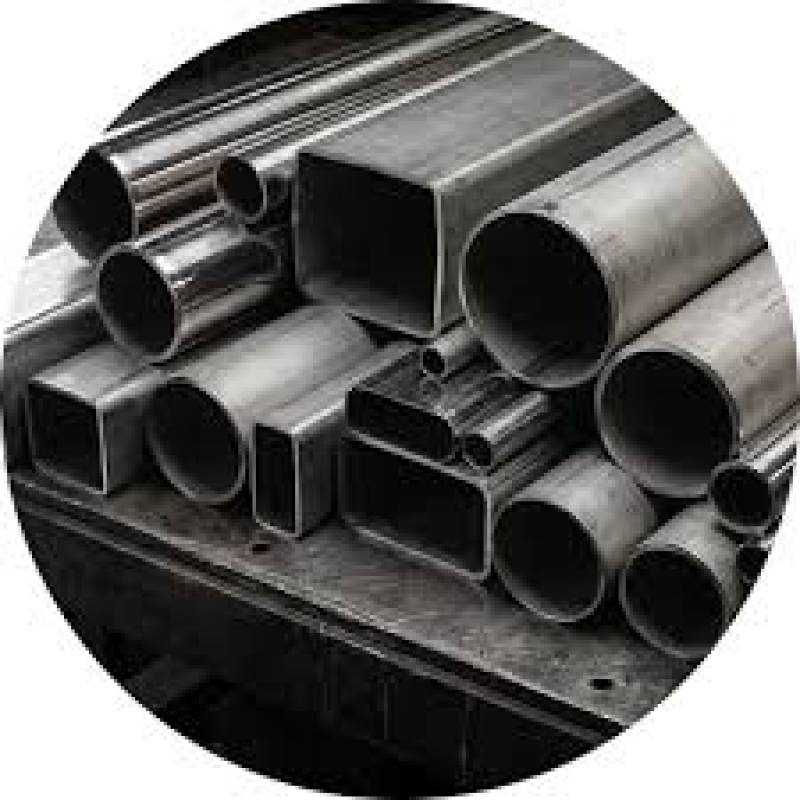
Each grade is available in seamless, welded and ERW construction, in round, square and rectangular profiles, subject to size and availability at the time of order.

|
SS 202 Pipe |
Lower-nickel, higher-manganese austenitic grade (~17-19% Cr, 4-6% Ni, 7.5-10% Mn); budget alternative to 304 |
Dry indoor applications — furniture, interior railings, decorative trim |
|
SS 304 Pipe |
Standard "18/8" austenitic grade (~18% Cr, 8% Ni); yield 205 MPa, tensile 515 MPa |
General-purpose use — food processing, architecture, general industry |
|
SS 304L Pipe |
Low-carbon version of 304 (carbon capped at 0.03% vs 0.08%); yield 170 MPa, tensile 485 MPa |
Heavily field-welded parts where weld-decay resistance matters |
|
SS 316 Pipe |
Adds 2-3% molybdenum over 304 for much better pitting and crevice corrosion resistance from chlorides |
Marine, coastal, and chemically aggressive environments |
|
SS 316L Pipe |
Low-carbon version of 316 with the same molybdenum addition; yield 170 MPa, tensile 485 MPa |
Heavy welding in marine or chemical service |
|
SS 321 Pipe |
Titanium-stabilized grade; titanium binds with carbon so weld decay resistance holds without low-carbon content; yield 205 MPa, tensile 515 MPa |
Exhaust and thermal applications from 427°C to 816°C |
|
SS 310 Pipe |
High-chromium, high-nickel grade (24-26% Cr, 19-22% Ni) for extreme temperature service |
Furnace components, kiln linings, radiant tubes up to about 1,150°C in dry air |
|
SS 347H Pipe |
Niobium-stabilized, high-carbon-range grade (0.04-0.10% C); niobium carbides are more thermally stable than titanium and don't burn off during welding |
Refinery and power-generation piping — catalytic cracking units, boiler tubes — in the 400-815°C range |
General purpose. SS 304 Pipe covers the majority of standard applications — food-grade equipment, architectural work, general fabrication — where there's no unusual chloride exposure or high-temperature demand. SS 304L Pipe is the same grade adjusted for heavy welding.
Marine and chemical environments. SS 316 Pipe and SS 316L Pipe are built for chloride exposure — coastal structures, marine equipment, and process lines carrying aggressive chemicals. Choose the L version when the pipe will see significant field welding.
High temperature. SS 321 Pipe suits exhaust and thermal systems running between 427°C and 816°C. SS 347H Pipe is the fit for refinery and power-generation piping in the 400-815°C range where sustained strength and weld-seam stability both matter. SS 310 Pipe is reserved for the most extreme end — continuous service up to roughly 1,150°C in furnace, kiln, and radiant tube applications.
Budget and indoor use. SS 202 Pipe is the choice when cost matters most and the application stays dry and indoors — decorative and furniture-grade work rather than structural or outdoor use.
Siddhgiri Overseas is ISO certified for quality, occupational health & safety and environment management, and holds the import and export certification required to supply stainless steel pipe and tube to customers worldwide. Certificate copies are available on request for buyers who need them for their own compliance records.
Every batch ships with a works certificate recording the heat number, the chemical analysis and the mechanical results, which is what lets a positive material identification check on site reconcile cleanly. The certificate guide covers the EN 10204 types.
The works operates under ISO 9001, ISO 45001 and ISO 14001 certification, with PED requirements applied to export pressure material.
304L. The low carbon protects the weld zone; the molybdenum in 316 would be paid for and unused.
Usually yes. It meets the 304L carbon ceiling and the higher 304 mechanical minima at the same time, so one material satisfies either drawing and you do not take the strength penalty.
If the design is governed by ASME creep allowables at 540 °C and above, 347H. Below that, 321 generally does the same job for less. Both are stabilised; the difference is how the carbide behaves at the top of the range.
Tell us what the duty is rather than the grade, and we will say honestly whether we can supply something suitable or whether you need a duplex or higher alloy that is outside our range.
If you know the grade, send it with the size, wall, length and quantity. If you do not, send what the line carries, at what temperature, concentration and pressure, whether it will be welded, and whether it will be annealed afterwards. That is enough to answer the grade question properly.
SS 316 contains 2-3% molybdenum, which SS 304 does not. That addition gives SS 316 significantly better resistance to pitting and crevice corrosion from chlorides, making it the better choice for marine, coastal, or chemically aggressive conditions, while SS 304 remains suited to general-purpose use.
Choose an L grade when the pipe will be heavily field-welded. The lower carbon content (0.03% max) prevents chromium carbide precipitation in the heat-affected zone during welding, which avoids weld-decay corrosion. It comes with a modest reduction in yield and tensile strength compared to the standard grade.
It depends on the temperature and application. SS 321 and SS 347H are suited to sustained service in the 400-816°C range, with 347H specifically used in refinery and boiler piping. For continuous extreme heat up to around 1,150°C, such as furnace or kiln components, SS 310 is the appropriate grade.
SS 202 is generally the most budget-friendly grade in this range, since it replaces a portion of the nickel content used in SS 304 with manganese. It's suited to dry, indoor applications only and isn't recommended where moisture or outdoor exposure is involved.
Yes, it's common to specify different grades for different parts of the same project based on what each section is exposed to — for example, SS 304 for general piping runs and SS 316L for sections exposed to chlorides or heavy welding. Siddhgiri Overseas supplies across the full grade range so mixed specifications can be sourced together.
The "H" denotes a controlled higher-carbon range (0.04-0.10%), which helps the grade retain strength during sustained high-temperature service. Like SS 321, it resists weld decay through stabilization — SS 321 uses titanium, while SS 347H uses niobium, whose carbides are more thermally stable and don't burn off during welding, making 347H suited to demanding refinery and power-generation piping.
Yes. Siddhgiri Overseas has manufactured stainless steel pipe in Mumbai since 1962 and supplies this full 200-series, 300-series, and H-series grade range in both seamless and welded construction, with Mill Test Certificates provided for traceability.